Rack Colocation
Place equipment in a data centre with power and interconnection.
A rack fits equipment housed in a defined cabinet. Start with rack units, power and connections; space alone does not include network services.
Validate the facility, power, space, cross-connects, physical security and remote hands.
Let’s talk
How it works
Place equipment where you need connectivity, with defined space and power.
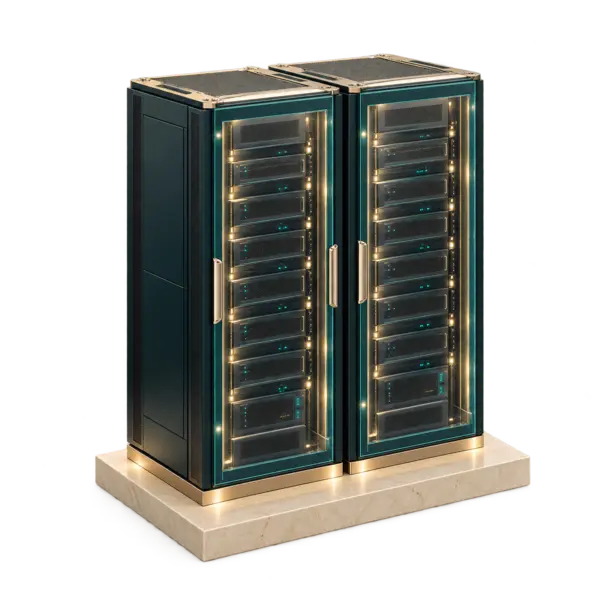 Customer rack
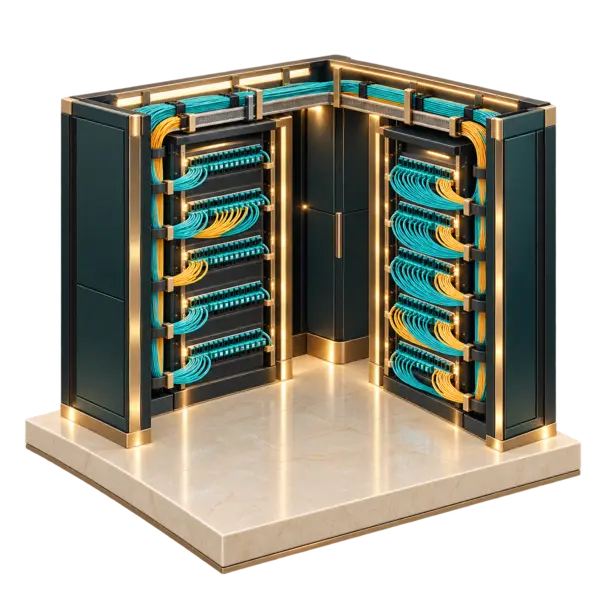 Internal interconnection
 Networks and services
From the rack to interconnection
The rack holds customer equipment. A cross-connect, or internal cable, connects it to the agreed handover; define who orders and maintains it.
Handover may be in an MMR (Meet-Me Room) or CEA (Common Equipment Area). Rack space, power and connectivity have distinct contractual scopes.
Customer rackInternal interconnectionNetworks and servicesLoad is also measured in power
Validate expected power, feeds, socket distribution and site-specific cooling. Adding servers may reach an electrical or thermal limit before filling the rack.
Distinguish contracted power, consumption and contingency capacity. Agree monitoring, physical access and interventions with responsible staff.
Customer rackInternal interconnectionNetworks and servicesCorrectly connected dual power
Resilient rack infrastructure requires suitable power supplies and connections distributed according to design. Two cables to the same origin do not prove independence.
Test access, notification and recovery without operating customer equipment outside scope. Building availability does not guarantee application availability.
Illustrative case: from situation to decision
- Situation
- Routers and servers need to sit close to an interconnection point.
- Option
- Size the cabinet, power and connections to the required carriers.
- Check
- Confirm usable space, power, operational access and each cross-connect’s demarcation.
Colocation houses equipment; it does not imply server administration or every connection is included.
Decisions for your project
- Space and power
- Dimensions, load, power feeds, connectors and cooling.
- Interconnection
- MMR/CEA, cross-connects, providers and demarcation.
- Operations
- Authorised people, maintenance, intervention and notifications.
From design to operation
Validate inventory and load, agree cabling and power, and accept handover using customer-equipment tests.
Complements, alternatives and variants
Product sources
What challenge would you like to solve?
Tell us what is happening and what needs to change. You do not need to know the catalogue.
What happens next?
- Understand the context
What’s changing, where your teams work and what cannot fail. Still defining the brief? We can help structure it.
- Design the options
Bring needs, Colt capabilities and technical criteria together. Compare alternatives and explain dependencies and limits.
- Validate before committing
Coverage, feasibility, responsibilities and terms. A commercial proposal is developed with the relevant specialists.
ColtPlatinum guides the project and coordinates commercial discussions and follow-up. Colt validates feasibility, enters into the service contract, and provisions, installs and delivers the services.
Availability, coverage, capabilities, SLAs and timelines are subject to technical validation and contract. No diagram is a service guarantee.